Showing posts with label Buddha. Show all posts

Friday, 14 July 2023

Silk Road treasures of the Humboldt Forum


1. Uighur princes and princesses. Wall paintings from Cave temple 9, Bezeklik, Xinjiang, est. 8th-9th C.

The Humboldt Forum is the newest of Berlin’s elite group of museums, all clustered on an island in the River Spree. These include the Pergamon (with the Ishtar Gate) and the Neues Museum (home of Nerfertiti), so the Humboldt has some tough competition. But none of the others can boast of two Buddhist cave temples, carried from the Taklamakan desert and re-assembled on-site. It was to see these, and the rest of the Humboldt’s world-famous Silk Road collection, that I visited Berlin in May. 

The Humboldt is the successor to two previously separate museums: the Museum for Asian Art and the Ethnological Museum which stood in a quiet suburb of Berlin. In the early 2000s, plans were launched to unite these collections with the other treasures on Museum Island. To house them, a replica imperial palace was built from scratch amidst much controversy and huge expense. The Humboldt Forum finally opened in 2021. Look at the size of it!

2. View of Humboldt Forum from the west. Source: © Asio otus / Wikimedia Commons

Utilising the 42,000 sq m of space has not been a problem. The collection holds over 500,000 objects from Africa, Asia, Oceania and the Americas: only some 20,000 are on display but they fill up the exhibition floors easily. Elsewhere, the bright modern interior is designed to accommodate workshops, seminar rooms and vast hordes of visitors. Curators from small cash-strapped museums (i.e. the vast majority) will be prostrate with envy.

What’s on display is beautifully presented, particularly in the galleries containing artefacts from Silk Road sites in Xinjiang, China. These were found and brought home by four German archaeological expeditions between 1902 and 1914, known as the Turfan Expeditions. The most “fruitful” forays were those involving Albert von le Coq, whose name like those of Aurel Stein and Paul Pelliot is synonymous with Silk Road exploration. Their stories are told in Peter Hopkirk’s book Foreign Devils on the Silk Road, which I can’t recommend enough.

Von le Coq was only an ambitious museum volunteer when he was allowed to lead the 1904 expedition, after the boss Albert Grünwedel fell ill. He grabbed his chance and found an amazing set of deserted Buddhist cave temples at Bezeklik, near Turfan. On hearing this, Grünwedel hauled himself over to Central Asia to rejoin the team, launching the third expedition. But being a quiet scholarly type and still unwell, he was often overridden by von le Coq, which had unfortunate consequences for some of their discoveries.

Soon after Grünwedel’s arrival, the team (on a local tip-off) uncovered the great cave temple complex at Kizil.  

3. Tarim Basin, Xinjiang, China

Ancient Buddhist cave temples are found across India, Central Asia and China. The ones at Ajanta, western India, date as far back as the 2nd century BCE. In structure, they range from tiny monastic cells to multi-room spaces with hallways, niches and shrines, decorated with sculptures and paintings of religious scenes.  

Kizil comprises more than 200 cave temples dating from the 4th to 7th century CE, dotted along a cliff-face in the northern Taklamakan. The largest are up to 20m deep and 15m in height. A Japanese team tried to explore them in 1902 but were hit by earthquakes. For the happy Germans (who came back again in 1913-14) it yielded a rich store of artefacts including the so-called Cave of the Ring-bearing Doves (image 4 below), a 6th C cave which the team named after the bird motif on its walls (image 5). In the world of Silk Road scholarship, its more mundane name is Cave 123. This is one of the two cave temples reconstructed at the Humboldt.

   4. Reconstruction of Cave 123. The central niche held a statue of the Buddha, which was gone before the Germans arrived. The two side doorways to the rear cell allowed devotees to walk round the statue (circumambulate) while praying. Source: Staatliche Museen zu Berlin, Museum für Asiatische Kunst

             5. Ring-bearing dove motif, Cave 123, Kizil. Source: DW.com (left, remaining section in Kizil). Sketch by Grünwedel (right), from his book Ancient Buddhist Places of Worship in Chinese Turkestan (1912).

The bird motif is quite hard to see, especially in the Humboldt’s soft light. What catches the eye immediately is the cave’s domed ceiling, divided into eight segments depicting the Buddha with bodhisattvas. On each of the side walls is a large image of the Buddha surrounded by his disciples. Many of the colours are still vivid, derived from elements such as lapis lazuli (blue), copper (green) and gypsum (white). The cave has been rebuilt according to precise measurements from Kizil itself, so you can walk through the narrow door as worshippers did 1500 years ago and marvel at the densely decorated space, only 3m wide. 

The domed ceiling is unusual for the time and place (barrel-vaulted ceilings were more common), suggesting a Middle Eastern influence from the nearby trading hub of Kucha. The Silk Road was an international trade route, so these caves were not as isolated then as they seem now. 

6. Domed ceiling of Kizil Cave 123. Coloured segments are originals; brown patches are filled in

7. Moving the two-tonne dome of Cave 123 to the Humboldt in 2018. For full story see this link.
Source:  Staatliche Museen zu Berlin

The reconstructed cave sits in the middle of a large hall whose walls are hung with other painted stone slabs brought back by the expeditions. Von le Coq called them frescoes but technically they are murals, painted on dry (not wet) surfaces. Some of these are over 2x2 metres, comprising several pieces fitted back together. Von le Coq and his assistant Theodor Bartus (the muscles of the team) were proud of their prowess at cutting out these slabs and packing them for transport; the method is carefully described in von le Coq’s memoirs. Grünwedel would have preferred to copy the images and leave them in place but was often over-ruled. 

Von le Coq and Bartus had had plenty of practice cutting up cave temples on their earlier foray at Bezeklik. Their haul from there included images of Uighur princes and princesses (image 1) whose colours were perfectly preserved under centuries-old layers of dry sand. What isn’t on display, though, is a set of fifteen huge Buddhist wall-paintings (each about 3x2 metres) from the same cave, which von le Coq also dispatched to Berlin. Because of their size and weight, the paintings could not be moved to safety in WWII, and all were destroyed when the old museum was bombed.
 
They were however reproduced in von le Coq’s book Chotscho (1913), which I consulted in the British Library. The book itself is like a concrete slab but it was well worth seeing its breathtaking images like the one below. The lines where the segments were stuck back together are visible. Chotscho was the German spelling of Khocho, now Gaochang, the nearest town to Bezeklik.

                8. Buddha in a pranidhi scene from Cave temple 9, Bezeklik, Xinjiang, 8-9th C. Original dimensions 3.25m x 2m.                    Pranidhi scenes, popular in Uighur Buddhism, depict past buddhas foreseeing the enlightenment of the present Buddha Sakyamuni. Source: Chotscho (1913), von le Coq

Back in the Humboldt, the adjoining gallery houses the second of its two caves: the Cave of the Sixteen Swordbearers (Cave 8), also from Kizil, dated 5th– 6th C. In this room the curators have tried to suggest the cliffs and sand dunes of the Taklamakan by building tall sloping blocks with doorways and narrow passages. The huge space is very dark, emphasising the dim light from the doorways.  Affixed along the passage walls are four paintings, each depicting four ornately dressed sword-bearing men who were probably the sponsors of the temple. These were found on the passage walls leading into the cave’s main chamber. 

9. One of four segments from the Cave of the Sixteen Swordbearers (Cave 8), Kizil, 5th-6th C. Approx 1.2m wide.

The men’s appearance has provoked much discussion due to their reddish-brown hair, light-coloured eyes, and Persian-style clothes with Sassanian motifs (see third figure from left). Men with similar features are seen in other paintings here, such as the monks in the Cave of the Painters (Cave 207, image 10). They are commonly described as Tocharians, which some scholars find unsatisfactory because it derives from an early analysis of their language which mistakenly linked them to the Tokharoi people of Afghanistan. Some scholars claim that they are Sogdians or Hephthalites. But there has been no conclusive identification so the term “Tocharian” is still used.

                     10. Buddha with bodhisattvas and monks, Cave of the Painters (Cave 207), est. 6th C. The monks in the lower left have reddish hair and pale round faces.

The two Kizil cave temples are the jewels in the Humboldt’s Asian collection. But like other major museums in the Western hemisphere, the Humboldt is being challenged as to why it still possesses these treasures. Their provenance is obviously suspect: the argument that archaeologists “rescued” them is only partly true. Some were decaying or looted, but others were in good condition and could have been copied and preserved on-site as recommended by Grünwedel. When you stand in the Cave of the Ring-bearing Doves, you wonder how von le Coq had the audacity to cut it up and send it 6000km overland to Germany. The fifteen great paintings from Bezeklik might have survived if they had not gone to Berlin: they were doing very well before von le Coq and Bartus turned up. 

Equally, it is certain that many caves had been looted or destroyed by locals even before the Germans arrived; the British and French teams reported the same. Aurel Stein, working in the southern Taklamakan, re-buried a set of stucco Buddhist statues which were too large to move, hoping to study them later. But before his return, the statues were found and destroyed by tomb-robbers looking for treasure. Elsewhere, poor farmers used the coloured pigments from cave murals as plant fertiliser. Xinjiang was China’s wild west then: the Qing dynasty was dying and the average citizen of this remote corner was just trying to survive. It was not until the 1930s that the Chinese government officially banned exploration by foreign teams.

A more constructive question is whether the Humboldt should repatriate these treasures, as it is doing with its Benin bronzes from Africa. China’s vast modern museums could house them easily; in fact the Kizil and Bezeklik caves are now well-developed tourist sites. But this raises the question of whether the artefacts should go to Beijing/Shanghai or more correctly to Xinjiang, just as the Benin bronzes have gone home to the kingdom of Benin within Nigeria, and not to Lagos. Perhaps the Humboldt would rather not wade into the hot mess of Beijing-Xinjiang relations.

My trip to Berlin ended in another hot mess (British Airways flight cancellations) but I’m delighted that I made the trip. Apart from anything else, entry to the Humboldt is completely free, thanks to Neil MacGregor, the ex-British Museum boss who headed the project from 2015 to 2018. Berliners who were horrified by the project’s €680mn price-tag may not be happy but I am likely to visit again, just not flying BA.


Bibliography

Buried Treasures of Chinese Turkestan (1928), Albert von le Coq

Chotscho (1913), Albert von le Coq

Altbuddhistische Kultstätten in Chinesisch-Turkistan (Ancient Buddhist Places of Worship in Chinese Turkestan) (1912), Albert Grünwedel

Foreign Devils on the Silk Road (1980), Peter Hopkirk

“A Place of Safekeeping? The Vicissitudes of the Bezeklik Murals”, Susan Whitfield, from Conservation of Ancient Sites on the Silk Road (2010), Getty Centre


Monday, 12 March 2018

Doors of Perception at Luang Prabang


These ornate double doors caught my attention when I visited Haw Pha Bang, the golden temple which lies in the grounds of the Royal Palace at Luang Prabang, Laos. Many temples in Luang Prabang have similarly dazzling doorways, usually depicting famous scenes from Buddhist literature. But you have to be quite familiar with the literature to make sense of the images, and unless you have been a keen reader of the Jatakas (the vast collection of stories about the Buddha’s path to enlightenment), some of the images can be a bit baffling.

So I was quite pleased to be able to decipher the images here. They depict one of the most famous scenes from Buddhist scripture, where Gautama Buddha, having at last achieved the state of enlightenment, is attacked by the demon Mara and his wickedly tempting daughters. They try to undermine the Buddha’s new-found equanimity by offering him all manner of worldly pleasures. But the Buddha touches the ground with his right hand and calls on the Earth to witness that he is enlightened and beyond all temptation. The Earth (sometimes portrayed as a goddess) responds accordingly: Mara is vanquished and his daughters are revealed as evil hags. This is the point when the Buddha is proven beyond doubt to have reached the transcendent state of Nirvana.

The sculptors at Haw Pha Bang have made it fairly easy to follow the story. On the upper left is the Buddha being attacked by the hideous many-armed Mara and his retinue of strange beasts.


On the lower left are the temptress daughters, wearing plenty of bling and striking their finest poses.


On the upper right, the Buddha sits newly resplendent on his lotus throne, his right hand calling the Earth to witness.


And below him sit a trio of women whose appearance at first I found puzzling. Because if these were meant to be Mara’s daughters revealed as evil hags, why did they look like normal women? 


Fortunately, just minutes earlier, I had seen a useful clue to this question: the royal family’s collection of illustrations to the Vessantara Jataka.

The Vessantara is the last of the Jataka stories and a great favourite among Laotian Buddhists. It tells the tale of Prince Vessantara (an incarnation of the Buddha) who willingly suffers all kinds of losses and even gives away his wife and children – a bit like Patient Griselda in Bocaccio’s Decameron. At its heart is the Buddhist precept of non-attachment to all things temporal. For our purposes however, the key element is the preamble, where the prince’s mother (on learning that she is pregnant) asks the gods for ten special favours. According to the description in the Royal Palace, she wishes not only that her child will be a great leader, but also (and this really caught my attention) that she will retain her youthful figure after childbirth, and specifically that her breasts will remain firm and not sag like those of other women. The Royal Palace’s English translation is actually more graphic than this.

Having gotten over my unexpected coughing fit, I found that this anecdote helped to explain the final images on the temple doors. A key indicator seems to be that the three women’s breasts have succumbed to gravity, instead of remaining supernaturally perky like those of the temptress daughters on the left. Other clues are their walking sticks, their practical hair-styles and their lack of jewellery. 

My first response was a feminist snort of disdain, bearing in mind that Haw Pha Bang was actually built in the late 20th century when (as I harrumphed to myself) the sculptors should really have known better. But thinking further, one could argue that the sculptors were seeking to distinguish between fantasy and reality. The left door is about the perils of self-doubt and illusion, while the right door is about remaining grounded in reality. Perhaps I’m trying too hard here?

The image of the Buddha touching the Earth with his right hand is one of the key mudras or hand gestures in Buddhist art. The position, known as bhumisparsha mudra, is a particular favourite in Thailand, for example in this 15th-16th century bronze from Ayutthaya, in the collection of the Musée Guimet, Paris.


While researching this piece, I was delighted to learn that the Ashmolean Museum, Oxford, will be holding an exhibition of Burmese and Sri Lankan artifacts relating to the Vessantara Jataka. This coincides with the start of my third and final module at SOAS, which by happy coincidence is on Buddhist Art. Check out the Ashmolean exhibition here.


Wednesday, 22 November 2017

The Pensive Prince: beautiful art from a miserable time

This 6th century marble stele was the star attraction at this season’s sale of Chinese Buddhist art at Eskenazi in London. Despite its age, it still has traces of original gilding and paintwork. The central deity is in near-pristine condition, as are the nineteen attendant figures, two small dragons and the pair of lion-dogs under his feet. Arched above these figures are the scalloped leaves of a gingko tree. And that’s just the front! The 65cm-high stele is carved on the sides and back as well.


Although the deity is not named, this image is typically recognised as Maitreya, whom some Buddhists believe will return in future as the next incarnation of the Buddha. He sits in the so-called “pensive” pose: one leg over the other, his eyes downcast and his right hand held up to his cheek as he ponders the mysteries of life. The Chinese have a delightful name for this type of image: siwei taizi, the Pensive Prince. Given what was happening in China at the time, you couldn’t blame Maitreya for feeling pensive either.

The Eskenazi sale is called “Six Dynasties Art from the Norman A Kurland collection”, but nearly all the items come from the Northern Wei (386-534 AD) and Northern Qi (550-557 AD) dynasties. This places them at the latter end of the Six Dynasties period which stretched from the fall of the Han in 220 AD to the rise of the re-unifying Sui dynasty in 581 AD.

The history of this period is so complicated and depressing that it’s mostly glossed over in popular accounts (apart from the 3rd century Romance of the Three Kingdoms, which doesn’t cover the remaining 300 years of misery). It was a prolonged period of chaos, with various clans scrapping over the remains of the Han empire while trying and failing to fend off the Tuoba invaders from the north. Eventually the Tuoba established the Northern Wei dynasty, occupying what is now the north-central half of modern China (see below). The southern half was ruled by an equally confused set of short-lived dynasties but fortunately that doesn’t concern us here.


It was during this time that Buddhism replaced Daoism and Confucianism as the main religion, possibly because its message of peace and re-birth was so attractive to people who had suffered decades of war. The Tuoba, who were Buddhists themselves, helped to promote the religion through their patronage of religious art. This continued under one of their successors, the Northern Qi, to which period our stele is dated.

Examples of this type of stele are relatively rare. One of the better-known is at San Francisco’s Asian Art Museum (see below), also from the Northern Qi although in less good condition. The Smithsonian’s Freer Sackler Gallery has two: an unusual one with twin Maitreyas (see below) and one which it freely admits is a fake, sold to Charles Freer in 1909! That does suggest, though, how long there has been an interest in Six Dynasties Buddhist sculpture.

Source: Asian Art Museum, San Francisco

 Source: Freer Sackler Gallery, Smithsonian

Not all art from the period is as refined as this: there are a lot of comparatively workmanlike stone steles from the earlier 6th century. But they also have an interesting story to tell, because they were commissioned as acts of piety in anticipation of a coming apocalypse called the mofa. Followers of the Pure Land school of Buddhism were led to believe, based on totally accurate calculations of course, that the world would plunge into darkness and spiritual chaos in 552 AD. After this point, the cycle of re-birth that helps mortals to attain Nirvana would cease to function and their souls would wander lost forever. Their only hope was to be re-born instead into a pure land called Sukhavati but this was only for true believers. Commissioning a stele engraved with prayers for the merit of friends and family would help you to earn a place in Sukhavati. 

History doesn’t describe how the Pure Land devotees felt as the year 552 came and went, but luckily for us, this didn’t affect the practice of commissioning religious images as a merit-earning act. A close relative of our stele, found in Hebei Province in 1978, is dated 562 AD and bears an inscription from its donor stating “The beneficiaries of this pious act are the emperor, teachers and parents going back seven generations, all beings living and deceased, ordained clerics, as well as secular believers”. An interesting feature of our stele is that, for whatever reason, it is not inscribed.

Objects like the Maitreya stele are the reason why I study Chinese art: otherwise, I would never have heard of China’s Dark Ages, the Northern dynasties or the Pensive Prince. Looking at the stele five years ago, I would have been more impressed by the perfect little expressions on the faces of the lion-dogs. Which is not to say that they aren’t still my favourite feature. They’re irresistible! 


Reference material: "Six Dynasties Art from the Norman A Kurland Collection" (Eskenazi); "China: Dawn of a Golden Age" (Met Museum NY); "Wisdom Embodied" (Denise Patry Leidy);"Prince Moonlight: Messianism and Eschatology in Early Mediaeval Chinese Buddhism" (Erik Zurcher). 


Tuesday, 27 September 2016

To Famen and back - and still searching

This 9th century Tang Dynasty reliquary, made to hold a fragment of bone from (allegedly) the Buddha himself, is one of my favourite pieces of Chinese Buddhist art, and I was very much hoping to see it on my recent trip to China. But as I trailed round the museum of the Famen Temple at Xian, where it was discovered in the 1980s, it remained stubbornly out of sight. There were all manner of reliquaries on display: originally there were four separate sets containing three decoys (or “shadow bones”) and one true fragment. But I just couldn’t track this one down.
It’s not like it would be easy to miss. Standing around 38cm (15 inches) in height, it is made of dazzling silver-gilt studded with pearls. The base is shaped as a lotus throne, each petal containing an image of the Buddha. The richly adorned figure at the top is a bodhisattva, a celestial being who has chosen to remain on earth to help poor mortal souls (the most well-known bodhisattva is probably Avalokitesvara, worshipped as Guan Yin in the Chinese canon). Down on one knee, he holds up an ornate tray which would have contained the bone fragment (or decoy).
The inscription indicates a date equivalent to 871AD and suggests an imperial commission by the then Emperor Yizong, of whom history has nothing good to say (“unstable, cruel, inexperienced and capricious”, says historian Ann Paludan). In commissioning this piece however, Yizong was simply following a longstanding belief of Chinese Buddhism, which was that great offerings brought great spiritual merit. It didn’t really work for him: he was dead within two years and the Tang dynasty collapsed some forty years later.
I can’t really say why I like this piece, with its eye-smacking degree of bling. I think it’s because under it all, the craftsman has given the bodhisattva (with its slight incline of the head) a genuine air of wanting to do good which isn’t eclipsed by the gaudy jewels or the ghastliness of the imperial patron. He’s going to kneel there and offer that bone (or decoy) because that’s what a bodhisattva does: he doesn't give up on the world.
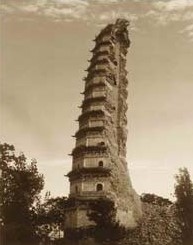
The discovery of the reliquaries is quite a story in itself. The Famen Temple (built on the site of a much older place of worship) blossomed from the late 6th century onwards as the Sui and Tang Dynasties, both devout Buddhists, came to power. In 1981, half of its famous pagoda collapsed in torrential rain (see below). When repair work began in 1987, an underground chamber was discovered containing a cache of precious religious artefacts, including the four sets of reliquaries.


Today the temple and pagoda have been sensitively restored and look like this.

In 2009 however, the regional government and the temple authorities decided to expand the neighbouring plot of land to create a modern annexe, capable of accommodating the thousands of visitors from China’s burgeoning local tourism trade. So they built this.


Which is so vast that you have to get around on one of these.


But whatever you may think about 21st century bling, I really enjoyed my visit to the Famen, which is just as well as I may have to go back one day to see if I can find the bodhisattva.