Showing posts with label Indus Valley. Show all posts

Saturday, 21 April 2018

So hungry you could eat an elephant


Source: British Museum

This Indian musical instrument (a sarinda - like a small violin) caught my eye in the British Museum. Made of ivory in the early 18th century, the main body is carved with images of flowers and angels, while the scroll-end depicts a monster devouring an elephant and clutching another in its claws (above right). The artist had a macabre sense of humour, because the sarinda is played in an upright position, so the musician would have the monster staring straight at him! On the other hand, I wonder if this was a decorative piece only, as ivory surely wouldn't produce good resonance for a stringed instrument.

By showing the poor elephant sliding into the monster’s maw, the artist persuades us that the monster must be enormous. It’s a neat trick that is also seen for example at Gangaikonda Cholapuram, the magnificent South Indian temple built in the 11th century by Rajendra Chola I. In this case, the image is carved beside a doorway to act as a threat to trespassers.


The elephant’s size makes it a good snack for monstrous appetites. This occurs in another popular image in Indian art: the god Vishnu rescuing an elephant from the makara, a crocodile-like monster. As told in the Bhagavata Purana, the king of the elephants was having a quiet drink from the river when it was seized by the makara and held in a death struggle. The elephant prayed to Vishnu, who swooped down and killed the monster with his deadly sudarshana chakra (a sharp-edged spinning disc). In artistic renderings, Vishnu is often portrayed as the handsome dark-skinned young avatar Krishna, accompanied by his flying companion Garuda who seems to be a kind of parakeet in the example below. You can also see the chakra embedded in the makara's neck. The scene is known collectively as Gajendra Moksha, the Liberation of the Elephant King.

Source: Victoria & Albert Museum
It’s not hard to see where the idea of the makara came from: India is home to three large species of crocodile, two of which (the saltwater and the mugger) regularly attack humans, while the gharial is harmless but grows to over 5 metres. Their presence was noted by the armies of Alexander the Great when he reached the Indus River in the 4th century BC. He thought he’d reached a section of the Nile because it was the only other place where they had seen crocodiles.
And crocodiles do actually attack elephants, as shown in this photograph taken in Zambia in 2010 (see also this article). A Google search turns up at least three recorded incidents in the past 10 years. In all these cases the elephant survived, so clearly Vishnu is still standing by when needed. But if you ask me, it’s never really safe to go back in the water. 

Source: Scientific American


Sunday, 21 August 2016

Indus Valley seals: tiny objects of mystery

Having enjoyed the new Bollywood epic Mohenjo Daro, I’m devoting this next post to Indus Valley seals: not just because they feature in the film’s plot but because (like the plot) they are quite mystifying. Even the film’s lead actor, Hrithik Roshan, looks beautifully perplexed.


Mohenjo Daro is one of the most important ancient cities so far discovered on the South Asian subcontinent, rivalled only by Harappa which was the first to be found. Both lie in the Indus valley in modern-day Pakistan and have been dated to the 3rd millennium BC. To put that in context, they were of about the same period as the Minoans in Crete, and pre-dated the reign of Tutankhamun by several centuries.
Although both Harappa and Mohenjo Daro were large and probably wealthy cities, not many of their fine artefacts have survived. Among the most interesting, however, are some tiny pieces of steatite or soapstone, about 4cm square, intricately carved on one side and with a little handle on the back. Historians believe that these were used as seals, perhaps by tradesmen who wanted to mark bundles of goods. The image below from the Metropolitan Museum shows one of these seals (left) and its resulting imprint (right).
Before looking at the images on the seals, it’s worth noting that the symbols along the upper edge are examples of Indus Valley script, which remains undeciphered to this day. In the Internet age, it is humbling to come up against something like this. Until we find a Rosetta stone or an Alan Turing to decode the script, our understanding of the Indus civilizations will remain sadly incomplete.
The images on the seals are equally fascinating. The Met’s is a classic because the animal shown (which is surely a bull or buffalo) has been described by fanciful observers as a unicorn because it has only one horn. I’m not sure anyone truly believes this but it provides good fodder for lengthy academic argument.
Other seals have even more complex imagery. The one below (from the National Museum in Delhi) is famous because some believe that it depicts an early incarnation of the god Shiva, flanked by a rhinoceros, a buffalo, a tiger and an elephant. One of Shiva’s titles was “Lord of the Animals” or “Pashupati”, hence the seal is commonly referred to as the Pashupati seal.

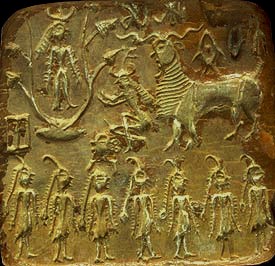
 In the one below (from the Islamabad Museum), a religious ceremony seems to be in progress: in the upper left, a figure stands in a tree while another figure kneels in worship. To the right there seems to be a bull with a human face, while along the bottom is a row of seven women. One suggestion is that they are ancient ancestors of the Matrikas, the Hindu goddesses who always appear in a group of seven.


Some other seals are so strange that they must have been used for purposes other than trade. I can’t imagine how the one below (a horned woman attacking a tiger) would find favour among clients, unless the goods or services were very specific indeed.  Pest control, perhaps?

To be fair, there are some unusual corporate logos still in use today – I’ve never understood how a picture of bees swarming around a dead lion helps to sell Lyle’s Golden Syrup, for example (below). The slogan “Out of the strong came forth sweetness” doesn’t explain much.

But what if the seals’ undeciphered pictograms are actually slogans as well? “Unicorn Cattle Feed – nourish your mythical beast”. The key to the code must surely be found someday, perhaps in a dusty museum archive. Until then, it’s a waiting game.