Showing posts with label China. Show all posts

Sunday, 22 September 2019

The best things I learned about ceramic glazes

The study of ceramic glazes was a challenging summer project, to say the least, but I came away even more impressed by the ingenuity of ancient Chinese potters. The project made me re-assess my views on some of their wares, one category in particular. And I only covered a few Tang and Song ceramics: the others like Yue, Yaozhou, Qingbai and all the post-13th century wares will have to wait, as my new academic term begins in a few days.

I wrote four detailed posts (not counting this one) and I'm sorry if they don’t make light reading: as I said in July, this was something I needed to get my head around. To make up for that, here is a "Best Of" list to give you an idea of the most interesting features. There are embedded hyperlinks in case you’re unexpectedly overcome by a thirst for knowledge!

1. Si, Al, Colour and Flux
Not the members of a Cantonese boy-band but the four things you need in a glaze. Silicon (chemical symbol Si) makes it glassy, aluminium (Al) makes it clingy, and various minerals like iron, copper or cobalt give it colour. But the key component is the flux (such as lead, potassium or soda ash): it is the go-between agent that encourages the other elements to melt easily and coat the pot smoothly without cracking. This is why glazes are often referred to by their fluxes: lead glaze, lime-ash glaze, lime-alkali glaze, etc. More about glaze chemistry here (about halfway down).

2. Iron makes the most amazing colours
From left: Tang sancai horse and rider, Ru dish (upper), Longquan dish (lower), Longquan vase with iron-spot decoration.

We think of iron as a heavy black metal, but all the above objects owe their colours to varying levels of iron in the glaze. The amber-brown shade of sancai ware, the blue-greens of Ru, Guan and Longquan, and of course the iron-spots of Longquan tobi seiji, are all derived from iron. The final colour depends on various things: the percentage content (as little as 2% iron can be enough), the level of titanium dioxide in the glaze (too much makes the iron go yellow), and the temperature and atmosphere of the kiln. Next time you admire a dreamy green celadon, remember that its colour comes from the same mineral later used to make railway engines.

3. Ru is rare, Guan is brilliant…
Ru ceramics are famously rare (fewer than 100 pieces remain), beautiful and staggeringly expensive. But it turns out that the glaze, while lovely beyond doubt, is not unusually complex from a technical POV. It’s a reworking of ancient Shang ash glazes but with a bit of iron and a lot of obsessively careful firing. You could argue that this simplicity is part of its charm but I suspect that the enduring popularity of Ru is more about its rarity and historic links to the tragically deposed Northern Song. More details in the middle section of this post.
Ru ware narcissus bulb planter with uncrackled glaze. China, Northern Song Dynasty, 12th C. 
National Palace Museum, Taipei.
Guan is partly inspired by Ru ware but it’s a very different creature. The abstract patterns of its crackled glaze are bold and modern, yet they also reflect the dynasty's sad past. More importantly, the potters’ idea of using low-silica materials to make this crackle (when the received wisdom was that silica prevented cracking) was a brilliant bit of experimentation, especially when working with unfamiliar southern clays. More info in this post.

Guan dish, D: 22cm. Southern Song, 12-13th C. Met Museum NY

4. But Jun is astounding
The glaze that most impressed me was Jun, a blue ceramic from the Northern Song period. Jun ware has a misty shimmering quality known as “opalescence”, sometimes enhanced with purple splashes of copper pigment. It is not especially rare, and I always thought it was a bit florid by Song standards.

Jun ware dish, Northern Song period, 11-12th C. British Museum (Percival David Collection)
But I hadn’t realised that Jun glaze is not really blue at all. Its colour comes primarily from its molecular structure which scatters blue light in the same way as the Earth’s atmosphere makes the sky look blue. The glaze on its own is straw-coloured but if applied thickly, it can make the underlying object look anything from milky blue (if under-fired) to purplish blue (high-fired). It was not until 1983 that two scientists worked out the chemistry behind this, introducing the phrase “liquid-liquid phase separation” to the world of art history. For more info, see the last section of this post.

While researching these posts, my most frequent question was “how did they work that out?”. How did potters know that adding crumbly white stone to the glaze would make it come out green? I tried asking a couple of modern ceramic artists about their glazes and wow, they clammed up fast, as if I’d asked for their PIN numbers or email passwords. Because of course it took years of work and repeated failures before the glaze finally came right: they weren’t going to just tell me all. Likewise with the potters of the imperial kilns (more to the point, the emperor would have been furious if they revealed the secrets of imperial wares). But I hope at least they would have been entertained by my efforts to study their work. 

Main sources used: Chinese Glazes (1999), Nigel Wood; Science & Civilisation in China, V5 Pt 12 (2004 edition), Rose Kerr and Nigel Wood; Song Dynasty Ceramics (2004), Rose Kerr.

Wednesday, 18 September 2019

Crackle and bubbles - ceramic glazes of the South

The future looked bleak for the Song dynasty after its defeat by Jurchen invaders in 1125-26. The court fled south to Hangzhou, where the Emperor Gaozong (a master of spin) promoted the use of art and literature to win allies amongst the powerful literati class. Out of this arose the two ceramics most commonly associated with the Southern Song: Guan ware and Ge ware.
Guan brush washer, D: 12cm. Southern Song, 12-13th C. Christies Ltd.
Guan stoneware bears some resemblance to Ru ware, which was closely associated with Gaozong’s father Huizong.  In a way therefore, it acted as a reminder of the legitimacy of Gaozong’s rule. But at a deeper level, Guan (which means "official") is a very different creature, not least because the Hangzhou potters had to learn to work with local materials. For the glaze recipe, they followed more or less the Ru approach, using lime (calcium oxide) as a flux and iron for a bluish tone. But they experimented widely with production techniques, so Guan ware may vary between pale blue, green or tan, and the glaze may look opaque or glassy, depending on kiln temperatures (in the 1200-1250°C range) and atmospheres. The underlying clay bodies are dark and iron-rich, often showing through at the rim and base, a feature known as “purple mouth, iron foot”.
Guan eight-petal lobed dish, D: 17cm. Southern Song, 12-13th C. British Museum
While Ru ware is very subtly crackled, the Guan potters had no such inhibitions. A strikingly crackled glaze is the key feature of Guan, which often looks worn and ancient. The method used to produce this was revolutionary. The southern potters experimented with levels of silica (SiO2) which normally prevents crazing. They discovered that if both body and glaze were low in silica (around 65% instead of 70%), a conspicuous crackle could be achieved under the right firing conditions. Kerr and Wood, not usually given to hyperbole, describe this as “one of the greatest artistic achievements in Chinese ceramic history”.
Foliate dish, described as Ge ware. D: 14cm. Southern Song, 12-13th C. Christies Ltd.
Ge ware (ge as in 哥 or “older brother”) is a famously tricky subject. Many experts believe that what is commonly described as Ge ware is just a paler off-shoot of Guan ware. Ge is not mentioned in any known Song dynasty texts (it's first mentioned in Yuan texts) and no evidence has been found of a separate kiln. The key attributes of Ge (lighter-coloured bodies, more layers of glaze, deeper crackle) can all be explained by variances in production technique – and as we know, the Guan potters were an adventurous lot. The Palace Museum, Beijing, staged an exhibition dedicated to Ge ware in 2017 but even they were careful not to date everything to the Song period. Major auction houses sometimes offer pieces as “Ge ware” (including the ones pictured here) with appropriate caveats. But tellingly, neither of these lovely pieces found buyers at auction, so collectors are obviously cautious too.
Brush washer, described as Ge ware. H: 7.3cm, Southern Song, 12-13th C. Sotheby’s Ltd.
This poses an existential problem for glaze analysis: how do you select a piece for testing if you cannot be sure that it is Ge, because does Ge exist as a separate category in the first place? We know that these pieces also exhibit low silica levels in body and glaze, like Guan. It is worth noting however that the prettiest examples of Ge ware (like the ones shown here) have a distinctive double-pattern of crackle: an inter-woven network of dark and light lines which have been stained for effect, poetically named “gold thread, iron wire”. These intricate pieces argue for Ge’s place among the Five Great Wares. Except of course that they may be Guan. 

Conversely, there is plenty of evidence that Longquan existed in the Song period but it is not listed among the Great Wares, probably for two reasons. First, it was not made in an “imperial” kiln but was widely produced in Zhejiang (the coastal province south of Shanghai) for domestic and export markets. And although well-known in the Song period, it was in the early Yuan dynasty that its reputation was at its height and production boomed.

(Left) Longquan mallet vase, H: 17cm. V&A Museum. (Right) Pair of Longquan funerary urns, H: 25cm. British Museum. Southern Song, 12-13th C.

Longquan (a type of stoneware) is one of the most beautiful and influential of the Chinese ceramics. It is the quintessential celadon, with elegant colouring ranging from duck-egg blue to sea green. It was exported as far as Istanbul, where the Topkapi Palace still has a fine collection; while in Japan every tea-master wanted a Longquan vase to accent his exquisitely minimalist tea-house. Celadons are still made in South-east Asia today, in Chiangmai for example. You can find classic designs like the “twin fish” motif - compare my cheap and cheerful modern replica with a 900-year-old version, below.

(Left) Longquan dish, D: 14cm. Southern Song, 12-13th C. British Museum. (Right) Longquan-type dish, D: 14cm. Probably Thailand, 20-21st C. 
Like most celadons, Longquan gets its colour from iron fired in a reducing atmosphere but analysis also shows a high level of potassium oxide (K2O) as a flux, hence it is referred to as a "lime-alkali" glaze. This thick unctuous glaze was applied in several thin layers between firings, and if the potters got it right, microscopic bubbles would form and become trapped in the lower layers. As a result, the best Longquan glazes have an unusual depth and complexity. Kerr and Wood point out how difficult it must have been to fire each glaze-layer consecutively without them all melting into one. 

Longquan vase with iron-spot decoration, H: 27cm. Yuan dynasty, 14th C. British Museum.
The Longquan potters became more daring with their designs in the Yuan dynasty. For the piece shown above, specks of raw iron were placed on the surface before firing, which resulted in dark brown decorative spots (also seen in wares like Qingbai but the Longquan kilns did it best). These were so popular in Japan that they gave it a name – tobi seiji (“flying spot green-ware”). The trumpet-necked vase shown here from the BM’s Percival David Collection was bought in Japan, where its almost-identical counterpart still resides at the Bridgestone Museum, Tokyo.  

Thursday, 5 September 2019

Minimalist cool - ceramic glazes of the Northern Song

After the bold colours of the Tang dynasty, the Song (as seen previously) preferred a more refined aesthetic. Some of China’s finest ceramics were developed in this period: collectors talk about the “Five Great Wares of the Song” - Ding, Ru, Jun, Guan and Ge, to which many would add the beautiful Longquan. The collage below shows examples of all six.

From top left clockwise: Ding, Ru, Jun, Longquan, Ge, Guan
This is a lot to cover, so this post looks only at Ding, Ru and Jun – ceramics that flourished in the earlier part of the dynasty (the Northern Song, 960-1125 AD).

Ding ware, a white ceramic from Hebei, northern China, stands out amidst the typical Song blues and greens. The thin clear glaze is so subtle that it is almost a varnish. The main ingredient is magnesium oxide (MgO), an efficient flux which gives a snug glossy finish and has low expansivity so the glaze can withstand high firing temperatures without cracking.

Ding ware is all about the body, which I was surprised to learn is classed as porcelain because it contains kaolin and is fired up to 1300˚C. I’d always thought of porcelain as a later discovery but according to Nigel Wood, some northern clays are kaolinitic and unusually pure, so early potters could make porcelain as long as the kiln was hot enough. Wood describes early northern Chinese porcelain (around 7th C AD) as “the first true porcelains in the world”.

Ding ware basin. China, N Song dynasty, 11-12th C. Percival David Collection. 

Ding potters worked the clay so thin that it couldn’t sit unsupported in the kiln, so the pots were fired upside-down on a support called a “sagger”. This gave the rim a rough finish, so it was enclosed in a strip of copper which fires into a lovely dark chocolate colour.

Xing ware vessels. Northern China, Tang dynasty. JJ Lally, New York.

Ding ware illustrates the effect of kiln atmosphere on glazes. Its creamy tone results from an “oxidising” atmosphere: where there is enough oxygen in the kiln to oxidise the glaze chemicals. Earlier white wares (like Xing ware, below) are a cool ice-white because they were fired in a “reducing” atmosphere, where the kiln is tightly enclosed and low on oxygen. Early potters used wood-fired kilns which tend to give a reducing atmosphere. Song potters more often used coal-fired kilns which made oxidising atmosphere easier to achieve.

 Ru ware cup holder with finely crackled glaze. China, Northern Song Dynasty, 12th C. British Museum.

Ru ware narcissus bulb planter with uncrackled glaze. China, Northern Song Dynasty, 12th C. National Palace Museum, Taipei.
Ru ware is known for its lustrous blue-green glaze, made for the Emperor Huizong around 1100 AD and wildly desired by collectors ever since. Unlike Ding ware, Ru ware is all about the glaze: the underlying stoneware body is kept simple. The glaze is actually a descendant of ancient Shang lime/ash glazes, using high levels of calcium oxide (derived from wood-ash or limestone) as a flux. But the Song potters added a bit of iron (Fe2O3) which gave that beautiful blue-green when fired to about 1200˚C in a reducing atmosphere. 

It’s almost disappointing to learn that the beauty of Ru comes from something as mundane as iron, albeit in the hands of genius potters. We’re lucky to know this though, as there are fewer than 100 pieces in existence, each worth a king’s ransom (the one below sold for US$37mn in 2017), so even broken shards are hard to obtain for chemical analysis!

Ru brush washer with crackled glaze, D: 13cm. China, Northern Song, 12th C. Sothebys Ltd. 

Ru ware introduces the riddle of the crackled glaze. The technical term for cracks in glaze is "crazing", a fault which usually results in the piece being discarded, but it seems both crackled and non-crackled Ru pieces were equally prized by the imperial court.

Crackle occurs on ceramics if the glaze and body cool at different speeds after firing and the glaze no longer “fits” the body. An effective flux and proper kiln control helps prevent this. Yet most existing Ru pieces are finely crackled, some in ways so delicate that collectors have named the patterns: “cicada’s wing”, “fish scale”, “crab claw”, etc. It is believed that these were defects that later became desirable, the way that Japanese art values imperfections (and wouldn’t it be typical of the Song intellectuals to take that view).

The colour of Ru is compared to “the sky after rain”, which is ironic because it is Jun ware that is truly sky-blue. The colour of the sky is a trick of light through atmosphere: similarly, Jun glaze only appears blue because the glaze bends the light in that way.

Jun dish, Percival David Collection (above left). Jun bowl, V&A Museum (bottom left). Jun vase with copper splashes, Christies Ltd (right). China, Northern Song period, 11-12th C.
The luscious shades of Jun, a type of stoneware, have a cloudy tinge known as “opalescence”. Many pieces also have bold splashes of purple for decoration, derived from copper oxide. My art history class loved Jun ware, because it was so easy to identify in exams!

Scholars love Jun too because the glaze is so complex. Under high magnification, its structure is like caviar made of tiny globules of glass. This is due to something called “liquid-liquid phase separation” (Google if you’re interested) which allows it to diffuse light by a process called Rayleigh scattering: the same thing which occurs when light hits the Earth’s atmosphere. And because blue light-waves are the easiest to scatter, Jun glaze and the sky both look blue. Apparently, when a chip of Jun glaze is held up to the light, it is straw-coloured: there is no blue at all. How is that not genius?

The opalescence was once attributed to phosphorus (which certainly plays a part) but scientists have now found that a high ratio of silica to alumina (around 7:1), plus the right quantity of calcium and potassium oxides, will cause liquid-liquid phase separation and hence the scattering effect. This only works within a narrow range of combinations, called the “zone of opalescence”, but the Jun potters seem to have nailed it.

(Left) Milky blue Jun bowl, D:17.7cm, Sotheby's Ltd. (Right) Darker blue Jun bowl, H: 8.9cm, Asian Art Museum San Francisco
The varied shades of blue do not come from specific chemicals but from different kiln temperatures. Jun is fired in reduction to about 1200˚C. If the piece is underfired (slightly below 1200˚C), the globules of glass are big enough to scatter both blue and white light, giving a milky blue colour like the bowl on the left. At higher temperatures, the globules get smaller and the colour goes to sky blue, lavender blue and even a purplish blue (the AAM bowl above). If the glaze is too thin, it reverts to greenish brown like the rim of the V&A bowl earlier (presumably because it’s not thick enough to scatter blue light).

Monday, 29 July 2019

Chinese ceramic glazes - a technical detour

I was going to begin with Tang ceramic glazes but like London public transport, some detours are inevitable on this journey.

Firstly, we can’t study glazes while ignoring the underlying body of the pot, as different pairings give notably different results. Traditionally, Western collectors have divided Chinese ceramic bodies into three categories: earthenware, stoneware and porcelain.

Earthenware is the oldest, dating back to the early Neolithic age (10,000 – 4,500 BC), possibly earlier. The one below from north-east China is dated around 2,500 BC. Like all ceramics, earthenware is made of clay, whose main chemical components are silicon dioxide (SiO2, known as silica) and aluminium oxide (AL2O3 or alumina). Earthenware is fired in a kiln at around 1000˚ Celsius, which is low by pottery-making standards. Primitive earthenware is unglazed but later versions (like Tang dynasty sancai ware) were glazed.

Earthenware ‘hu’ jar. Majiayao culture, China, 2650-2350 BC. Met Museum NY

Stoneware is also made of clay but with slightly different levels of silica and alumina, and is fired in a much hotter kiln, around 1,200˚ Celsius. It is a strong heavy ceramic, less porous than earthenware and usually glazed, making it more useful for household pots and jars.

Stoneware storage jar. China, 4th C BC. Minneapolis Institute of Art

Porcelain, the finest type of ceramic, is made with clay that contains or has been mixed with the mineral kaolin. Oddly, kaolin itself is mostly silicon and aluminium too but it strengthens the clay by a miraculous process called hydrogen bonding, allowing pots to be made thin and light yet strong. Porcelain has a glassy (“vitreous”) translucent quality. It may be fired at very high temperatures, up to 1,400˚C. Chinese porcelain is nearly always glazed, though modern potters sometimes make unglazed pieces to show off the fine underlying quality of their work.

Inevitably, the boundaries between these categories may be blurred, with academics tying themselves in knots to distinguish one from the other. Chinese scholars simply divide ceramics into low-fired or high-fired, and then categorise by style and dynasty (which I suspect is becoming the preferred approach).

Glazed ceramics were invented well before the Tang period: in fact, glazed stoneware was known in the Shang dynasty (1600 - 1050 BC). The yellow-green or grey Shang glazes were made from burnt wood ash. Kerr and Wood believe that once technology allowed kilns to get above 1150˚C, calcium and potassium oxides in the ash reacted with silica and alumina to form an “accidental” glaze when bits of ash fell on to the pots. Eventually, potters collected the ash and mixed it with water to make glaze. But we’ll look at ash and lime glazes in later types of ceramic, so I think we can conveniently skip the Shang. 

We can’t skip the subject of glaze chemistry however, and here again, silicon and aluminium are key players. A glaze is a kind of melted glass overcoat for the pot, so silicon - the main ingredient of glass - is vital. Aluminium oxide makes the glaze viscous and gluey so that it clings to the pot. In addition, a good glaze needs a “flux”. Fluxes are chemicals that encourage the glaze to melt at lower temperatures and become more flexible (“expansive”) so that it fits the body nicely and doesn’t crack. Fluxes are usually something alkaline like potash or sodium oxide, but historically one of the commonest was lead oxide, which we now know is poisonous. As seen in the previous post, lead is still used in some rural areas because it is cheap and extremely efficient.

The fourth key element of glaze is colour, which comes from heating various chemicals in different ways. This too may have been an accidental discovery by potters whose local materials had different chemical compositions. The result is further governed by temperature and levels of oxygen inside the kiln (“kiln atmosphere”). This is where the potter’s art really gets going. Common types of chemical are copper (for red or green), cobalt (blue) and iron (red, brown, yellow, green and sometimes even blue). Titanium dioxide (TiO2) interacts with iron to give a yellowish colour (with high TiO2) or a cool green colour (low TiO2). This will come into focus when we discuss green ceramics or celadons.

Ewer with copper red underglaze. China, 14th C. Early Ming dynasty. Eskenazi Ltd.

In practice, of course, early potters didn’t go around chemical-testing their ingredients. Glazes were made by mixing water or liquid clay with crushed ore or soil from a particular place, according to a recipe handed down by predecessors. An experimental potter might try something different and if successful, would invent a new type of glaze.

But this has provided quite enough to chew on for now, so again like London public transport, this post (intended for the Tang dynasty) terminates here.  


Thursday, 14 March 2019

Blossoms on ice - the Kangxi blues

Source: Lady Lever Art Gallery

After a nice warm February, the blossom is out on the trees in London – just in time for the return of cold weather. Even before global warming, this must have happened in 17th century China too, perhaps inspiring the motif on this jar from the Kangxi period (1661-1722) of the Qing dynasty.

Many people may recognise this piece – or think they do – as it has been so widely copied over the centuries. The pattern depicts blossoms of the ‘prunus’ family (which includes cherries, plums and hawthorn) against a background of cracked ice. It is believed that this symbolised the approach of spring, with winter ice beginning to melt and early blossoms starting to emerge. In 19th and early 20th century writing, jars of this shape were often called ‘ginger jars’, based on the belief that they were used to hold sweets like candied ginger as gifts for friends and relatives. This particular type of jar was sometimes called a ‘hawthorn’ jar because of its decoration but the preferred description now seems to be the ‘Kangxi prunus’ jar.

From the technical perspective, the jar is notable for several reasons. It is a fine example of underglaze blue decoration, the kind used on blue-and-white porcelain of the preceding Ming dynasty (though it was invented even earlier). This decoration is achieved by painting cobalt-rich pigment onto the raw surface before applying a clear glaze on top and then firing in a kiln. Sounds simple but unless the pigment, glaze, clay, kiln temperature and kiln atmosphere are exactly right, the whole thing becomes a smeary cracked mess. Even the experts at the famous Jingdezhen kilns didn’t always get it right – hence a thriving market today in discarded broken shards (probably the only genuine Chinese ceramics I will ever afford!). But successful examples have gorgeous blue tones with subtle patterns and images somehow held intact under the smooth glaze.

This type of jar is also notable because it sparked a kind of collectors’ mania in the early 20th century. Good examples of Ming blue-and-white were still extremely rare in Europe, so the early Qing dynasty pieces were considered the most desirable. Scholars like Stephen Bushell and R L Hobson wrote about them in glowing terms, and (slightly dodgy) dealers like Joseph Duveen encouraged their millionaire clients to snap them up. Some wealthy collectors proudly accumulated several Kangxi prunus jars, which you’d think would give them a clue about how rare they were (i.e. not terribly). One of them was bought by Lord Astor for 5,900 guineas in 1905, equivalent to about £470,000 today, setting a record price for Chinese ceramics which lasted for decades.

Like other manias, this one soon came to an end, partly because fine Ming blue-and-white wares became better known. Collectors also learned that the prunus jars were predominantly made for export, whereas many Ming pieces were intended for the imperial household, making them more prestigious. In 1997, the same Astor jar was sold at Christie’s for £27,500. Today, an average example may fetch £2000-3000 at auction. The Lady Lever Art Gallery in Liverpool has no less than nine in its catalogue, either purchased by Lord Lever in the early 20th century or gifted by some other wealthy collector. In contrast, the very knowledgeable Sir Percival David (active in the late 20th century) didn’t include any in his collection which now resides at the British Museum. The BM’s solitary example was a gift from Augustus Wollaston Franks, a 19th century collector.

For me, the jar has echoes of the first Chinese ornamental pieces that my parents bought in a department store in the 1970s (the old C K Tang store on Orchard Road, for any Singaporean readers), so I’m quite fond of it. To commemorate its brief heyday, here is a montage of all nine of the jars in the Lady Lever gallery.


Saturday, 7 April 2018

The emperor's war-horses keep up the fight

 On a recent visit to the V&A, I was taken aback by this strange clay sculpture of a horse from 3rd or 4th century China. Is that an asparagus growing out of its head?

Source: Victoria & Albert Museum

Anyway, it set me thinking about horses in Chinese art, and in particular those depicted on carved stone panels at the tomb of the emperor Taizong. Looking further into this, I learned something about the panels’ troubled history.

Taizong (r. 626 to 649 AD), the second emperor of the Tang dynasty, is revered in Chinese history as a great ruler: a fearless warrior, highly literate, concerned for the welfare of his people, and open to foreign trade and culture. In many ways, he laid the foundations for the brilliance of the Tang dynasty. The Tang ruling elite were passionate about horses and equestrian sports, including polo which was especially popular among women. They imported top-quality horses from expert breeders in Central Asia whose livestock was superior to the rather weedy local ponies. The Tang love of horses was reflected in their art, notably in the horse figurines which are a must-have for any wealthy Chinese antique collector (see below).

Source: Metropolitan Museum, New York

More importantly, good horses were vital to the army and therefore a symbol of dynastic power and prestige. Taizong led his troops into battle on a series of mighty war-horses which he loved so much that he chose the six greatest ones and had their images engraved on stone panels, each accompanied by a poetic epitaph which he wrote himself. In accordance with his wishes, the huge panels (each measuring 1.6m x 2m) were installed as part of his tomb complex at Zhaoling, 60km north-west of Xian in Shaanxi Province.

Source: University of Pennsylvania Museum of Archaeology and Anthropology

The most famous of the six panels (shown above) depicts the horse named Saluzi, or Autumn Dew. The story goes that while carrying Taizong into battle, Saluzi was hit by an arrow. Taizong’s army chief, General Qiu, pulled the arrow out of Saluzi’s chest then and there, the brave horse showing no sign of pain or suffering. The sculptor (whose identity is unknown) has portrayed Saluzi standing calmly with his legs angled slightly forward, bracing himself, while the general’s knees are bent to show the force needed to extract the arrow.

Each of the six horses was chosen because it carried Taizong to victory at a particularly important battle. All of them sustained serious injuries in the process: for example, the horse named Quan Mao Gua (Curly-haired) was hit by nine arrows but continued to surge forward bravely, as shown in the carving below – the picture isn’t very good but you might just make out two arrows sticking out behind the saddle. 

Source: University of Pennsylvania Museum of Archaeology and Anthropology

A black horse with white socks named Bai Di Wu (White-footed Crow) reportedly carried Taizong on an epic 100km ride through the night. His panel shows him in a “flying gallop”, all four feet off the ground, and his poetic epitaph reads:

With a sword long enough to touch the sky
And this swift steed that could run with the wind
On a gallop I recovered Long
With one look I brought peace to Shu.

倚天長劒, 追風駿足, 聳轡平隴, 囘鞍定蜀.

It turns out, however, that the panels are the subject of a long-running dispute between the University of Pennsylvania Museum, which currently owns the two shown above, and the museum authorities in Xian where the other four remain. According to the UPM’s records, it first received the two panels in 1918 on loan from the Paris-based Chinese art dealer Loo Ching Tsai (known as CT Loo). The museum eventually purchased them from Loo in early 1921 for $125,000. 

It emerged that the panels’ provenance was shady, to say the least. The UPM received a letter in June 1921 from a French collector named Paul Mallon, who thought they might like to know that he had paid a fellow Frenchman named Grosjean to “obtain” the panels from Taizong’s tomb in 1912. Unfortunately, the grave-robbers hired by Grosjean were “attacked by peasants” while carting the loot away. The panels were confiscated by local officials and sent to the district museum. And so poor Monsieur Mallon was left out of pocket, quelle domage

The next problem is that no-one knows how the panels ended up in the US. After their sojourn at the district museum, they turned up in Beijing in the possession of the new ruler of post-imperial China, the warlord Yuan Shi-Kai. CT Loo claimed that the shipment to the US was arranged by a local middleman who was authorised by “the supreme authority of the country”, implying that either Yuan, his family or someone in his government had approved the deal, which is perfectly plausible but impossible to verify.

CT Loo himself had a controversial reputation. An orphan who moved to France in 1902 as servant to a Chinese businessman, he became the pre-eminent dealer in ancient Chinese, Indian and South-East Asian art, catering to wealthy collectors and major museums in the US and Europe. Anyone studying the provenance of Asian antiquities in the West will encounter his name repeatedly: an online search of the Smithsonian’s Freer-Sackler collection turns up over 300 hits. As a result, he came to be viewed with suspicion for his links with objects of questionable origin, the Taizong horses being a well-known example. He always denied any wrongdoing, and was in fact known for his philanthropy towards Chinese causes up until his death in 1957.
   
So where does that leave our heroic horses? Demands for their return have been made by authorities in Xian every few years but the UPM is not giving in. Perhaps tellingly, the issue has not come up at the highest diplomatic levels, suggesting that the Chinese central government is not (yet) interested in turning this into an Elgin Marbles situation. Will this change in the new climate of Sino-US relations? The horses probably don’t mind: they’ve seen a lot worse.

Reference material: "Emperor Taizong and his six horses", Zhou Xiuqin, Orientations 32, No 2 (2001); "CT Loo: highs and lows of a great art dealer", presentation by Geraldine Lenain to the Asia Society, Hong Kong (link here)

Wednesday, 22 November 2017

The Pensive Prince: beautiful art from a miserable time

This 6th century marble stele was the star attraction at this season’s sale of Chinese Buddhist art at Eskenazi in London. Despite its age, it still has traces of original gilding and paintwork. The central deity is in near-pristine condition, as are the nineteen attendant figures, two small dragons and the pair of lion-dogs under his feet. Arched above these figures are the scalloped leaves of a gingko tree. And that’s just the front! The 65cm-high stele is carved on the sides and back as well.


Although the deity is not named, this image is typically recognised as Maitreya, whom some Buddhists believe will return in future as the next incarnation of the Buddha. He sits in the so-called “pensive” pose: one leg over the other, his eyes downcast and his right hand held up to his cheek as he ponders the mysteries of life. The Chinese have a delightful name for this type of image: siwei taizi, the Pensive Prince. Given what was happening in China at the time, you couldn’t blame Maitreya for feeling pensive either.

The Eskenazi sale is called “Six Dynasties Art from the Norman A Kurland collection”, but nearly all the items come from the Northern Wei (386-534 AD) and Northern Qi (550-557 AD) dynasties. This places them at the latter end of the Six Dynasties period which stretched from the fall of the Han in 220 AD to the rise of the re-unifying Sui dynasty in 581 AD.

The history of this period is so complicated and depressing that it’s mostly glossed over in popular accounts (apart from the 3rd century Romance of the Three Kingdoms, which doesn’t cover the remaining 300 years of misery). It was a prolonged period of chaos, with various clans scrapping over the remains of the Han empire while trying and failing to fend off the Tuoba invaders from the north. Eventually the Tuoba established the Northern Wei dynasty, occupying what is now the north-central half of modern China (see below). The southern half was ruled by an equally confused set of short-lived dynasties but fortunately that doesn’t concern us here.


It was during this time that Buddhism replaced Daoism and Confucianism as the main religion, possibly because its message of peace and re-birth was so attractive to people who had suffered decades of war. The Tuoba, who were Buddhists themselves, helped to promote the religion through their patronage of religious art. This continued under one of their successors, the Northern Qi, to which period our stele is dated.

Examples of this type of stele are relatively rare. One of the better-known is at San Francisco’s Asian Art Museum (see below), also from the Northern Qi although in less good condition. The Smithsonian’s Freer Sackler Gallery has two: an unusual one with twin Maitreyas (see below) and one which it freely admits is a fake, sold to Charles Freer in 1909! That does suggest, though, how long there has been an interest in Six Dynasties Buddhist sculpture.

Source: Asian Art Museum, San Francisco

 Source: Freer Sackler Gallery, Smithsonian

Not all art from the period is as refined as this: there are a lot of comparatively workmanlike stone steles from the earlier 6th century. But they also have an interesting story to tell, because they were commissioned as acts of piety in anticipation of a coming apocalypse called the mofa. Followers of the Pure Land school of Buddhism were led to believe, based on totally accurate calculations of course, that the world would plunge into darkness and spiritual chaos in 552 AD. After this point, the cycle of re-birth that helps mortals to attain Nirvana would cease to function and their souls would wander lost forever. Their only hope was to be re-born instead into a pure land called Sukhavati but this was only for true believers. Commissioning a stele engraved with prayers for the merit of friends and family would help you to earn a place in Sukhavati. 

History doesn’t describe how the Pure Land devotees felt as the year 552 came and went, but luckily for us, this didn’t affect the practice of commissioning religious images as a merit-earning act. A close relative of our stele, found in Hebei Province in 1978, is dated 562 AD and bears an inscription from its donor stating “The beneficiaries of this pious act are the emperor, teachers and parents going back seven generations, all beings living and deceased, ordained clerics, as well as secular believers”. An interesting feature of our stele is that, for whatever reason, it is not inscribed.

Objects like the Maitreya stele are the reason why I study Chinese art: otherwise, I would never have heard of China’s Dark Ages, the Northern dynasties or the Pensive Prince. Looking at the stele five years ago, I would have been more impressed by the perfect little expressions on the faces of the lion-dogs. Which is not to say that they aren’t still my favourite feature. They’re irresistible! 


Reference material: "Six Dynasties Art from the Norman A Kurland Collection" (Eskenazi); "China: Dawn of a Golden Age" (Met Museum NY); "Wisdom Embodied" (Denise Patry Leidy);"Prince Moonlight: Messianism and Eschatology in Early Mediaeval Chinese Buddhism" (Erik Zurcher). 


Sunday, 9 October 2016

A revolution in oils: patriotic art at the National Museum of China

If you ever visit the National Museum of China (and you absolutely must because it is fabulous), it’s worth looking at the permanent exhibition in Central Hall 1 entitled Masterpieces of Chinese Modern Fine Art. What this actually offers is a series of paintings depicting (mostly) events relating to the revolution. The style and subject matter are not everyone’s cup of tea but there’s no denying the power behind some of these works.

One eye-catching example is Lin Gang’s Joining of the Forces at Jinggang Mountain (above), said to depict a key moment in the revolutionary struggle when Mao’s forces made contact with those of a fellow commander. Everything is bright and breezy. The old lady on the left hobbles forward with a basket of supplies to support the cause. In the lower right background, a soldier brandishes his rifle and shouts the good news to comrades down the line.  Mao is taller than everyone else and quite improbably handsome. Even the horse (on the right) gazes at him with misty eyes. 
I was surprised to learn that this work was not created in the heat of revolutionary fervour but in the late 1970s, in the early days of the post-Mao era. Were such images still de rigueur then? Perhaps with the scandals of the Gang of Four trials, it was important to remind the public of the original aims of the revolution.
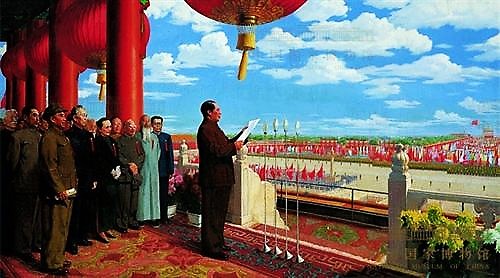
The most famous work on display in Central Hall 1 is Dong Xiwen’s The Founding of the Nation (below), depicting the moment when Mao announced the founding of the People’s Republic in 1949. This is in the approved style with references to classical Chinese motifs, such as the clouds which are supposed to resemble the auspicious lingzhi fungus (don’t ask). And you can’t miss those gigantic red lanterns!

This piece has a particularly curious history. Since its unveiling in 1953, it has gone through multiple “updates” to insert or remove figures in the group on the left. According to historian Chang-Tai Hung*, the following changes were made:
- In 1954, the figure of Gao Gang, a senior party leader, was painted out after he was accused of plotting to seize power.
- In 1967, the figure of Liu Shaoqi, ex-Chairman of the Chinese Communist Party, was deleted after he was condemned as a bourgeois reactionary.
- In 1972, the figure of Lin Boqu, a senior Politburo member, was deleted, ostensibly for opposing the marriage of Mao and his powerful wife Jiang Qing. As they had been married for 24 years by then, one suspects there were other reasons for Lin’s disappearance.
- And then in 1979, after the fall of Jiang Qing’s Gang of Four, all the above three figures were reinstated in the painting. One assumes that this is the final-final version, as everyone in it has been dead for some time.
Something else that’s interesting about this exhibition is the dominance of oil painting. Chinese artists in the 18th and 19th centuries tended to view oils as a strange foreign medium, inferior to the subtlety of ink brush painting. But this attitude changed in the 20th century under the influence of European-trained artists like Xu Beihong and because of China’s developing alliance with the Soviet Union. Russian artist Konstantin Maksimov, who taught at the Chinese Academy of Fine Art in the mid-1950s, is often cited as a major influence. He was a proponent of Social Realism in art, and his painting Sashka the Tractor Driver in Virgin Lands (below) certainly has something in common with the works in Central Hall 1. 

Even if this sort of thing doesn’t appeal, I urge you to visit the National Museum if you can. If you’re pressed for time, focus on the lower ground floor collection which is misleadingly entitled “Ancient China”: this actually contains a vast treasure trove of objects from the Neolithic to the Qing period. And there’s a very good museum shop.
*Comparative Studies in Society and History, Vol 49, No 4, Oct 2007, p.783

Tuesday, 27 September 2016

To Famen and back - and still searching

This 9th century Tang Dynasty reliquary, made to hold a fragment of bone from (allegedly) the Buddha himself, is one of my favourite pieces of Chinese Buddhist art, and I was very much hoping to see it on my recent trip to China. But as I trailed round the museum of the Famen Temple at Xian, where it was discovered in the 1980s, it remained stubbornly out of sight. There were all manner of reliquaries on display: originally there were four separate sets containing three decoys (or “shadow bones”) and one true fragment. But I just couldn’t track this one down.
It’s not like it would be easy to miss. Standing around 38cm (15 inches) in height, it is made of dazzling silver-gilt studded with pearls. The base is shaped as a lotus throne, each petal containing an image of the Buddha. The richly adorned figure at the top is a bodhisattva, a celestial being who has chosen to remain on earth to help poor mortal souls (the most well-known bodhisattva is probably Avalokitesvara, worshipped as Guan Yin in the Chinese canon). Down on one knee, he holds up an ornate tray which would have contained the bone fragment (or decoy).
The inscription indicates a date equivalent to 871AD and suggests an imperial commission by the then Emperor Yizong, of whom history has nothing good to say (“unstable, cruel, inexperienced and capricious”, says historian Ann Paludan). In commissioning this piece however, Yizong was simply following a longstanding belief of Chinese Buddhism, which was that great offerings brought great spiritual merit. It didn’t really work for him: he was dead within two years and the Tang dynasty collapsed some forty years later.
I can’t really say why I like this piece, with its eye-smacking degree of bling. I think it’s because under it all, the craftsman has given the bodhisattva (with its slight incline of the head) a genuine air of wanting to do good which isn’t eclipsed by the gaudy jewels or the ghastliness of the imperial patron. He’s going to kneel there and offer that bone (or decoy) because that’s what a bodhisattva does: he doesn't give up on the world.
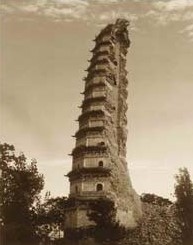
The discovery of the reliquaries is quite a story in itself. The Famen Temple (built on the site of a much older place of worship) blossomed from the late 6th century onwards as the Sui and Tang Dynasties, both devout Buddhists, came to power. In 1981, half of its famous pagoda collapsed in torrential rain (see below). When repair work began in 1987, an underground chamber was discovered containing a cache of precious religious artefacts, including the four sets of reliquaries.


Today the temple and pagoda have been sensitively restored and look like this.

In 2009 however, the regional government and the temple authorities decided to expand the neighbouring plot of land to create a modern annexe, capable of accommodating the thousands of visitors from China’s burgeoning local tourism trade. So they built this.


Which is so vast that you have to get around on one of these.


But whatever you may think about 21st century bling, I really enjoyed my visit to the Famen, which is just as well as I may have to go back one day to see if I can find the bodhisattva.

Tuesday, 9 August 2016

Matteo Ricci in the UCL art collection

At the Public Curating Takeover hosted by University College London last week (a great event, by the way), I was delighted to find this print in the collection. There was no mistaking the image of Matteo Ricci (on the left), perhaps the most famous Jesuit missionary ever to work in China. The figure on the right is named as Paul Siu, about whom more later.
The UCL catalogue does not name the artist, but other sources trace this image to a book (China Illustrata) published around 1668 by a Jesuit scholar named Athanasius Kircher. Whether Kircher actually executed the engraving himself is unclear. Judging from the rather muddled Chinese characters on the altar hangings, I would guess that it wasn’t the work of a Chinese artist.
Ricci first arrived at the fledgling Jesuit mission in southern China in 1582, when Christian missionaries were struggling to gain a foothold. He successfully applied the Jesuit strategy of “cultural accommodation”: adapting to local language and customs to spread the message, while dressing and living as a scholarly Chinese gentleman to win the trust of influential local people. Hence the significance of this image, in which he wears Chinese robes and a Confucian scholar’s hat. By 1601 Ricci had established the first Jesuit mission in Beijing itself and had begun to build direct ties with the Imperial Court, quite a coup by any standards.
For the art world, Ricci was important in at least two ways. First, he laid the way for Giuseppe Castiglione (a Jesuit priest and artist) to become an influential Qing dynasty court painter in the 18th century. Castiglione became noted for elaborate portraits like the one of the Qianlong emperor, below. His work is sometimes dismissed as trivial but he became a key member of the imperial atelier (pretty amazing for a foreign artist) thanks to foundations laid down by Ricci. These days, no exhibition of Qing art is complete without a few Castigliones – his portraits of imperial pet dogs are especially popular. 

But it is Ricci’s role in the clock-making industry that I find most fascinating. Mechanical time-keeping devices (the kind that run on springs and cogs) didn’t exist in 16th century China. When Ricci presented a pair of European clocks to the Wanli emperor in 1601, he set off an absolute craze for the devices. It seems the 17th century Chinese were as keen on modern technology as their modern descendants. And having studied the imported European models, they eventually set up their own clock-making workshops (mainly around Guangdong) which flourished as the growing middle classes all wanted one too. Hardly surprising, as some of the finest Imperial palace clocks looked like this (below), which sold at Christie’s Hong Kong in 2008 for US$4 million.

Best of all, according to the historian Joseph Needham, Matteo Ricci was worshipped well into the 19th century as a patron deity (pu-sa) of the Shanghai guild of clockmakers, due to his role in bringing modern clock-making to China. Now that’s cultural accommodation!
As for Paul Siu, he was born Xu Guangqi and brought up as a good Confucian. He rose through the ranks of Chinese bureaucracy to become a “first grand secretary” in the Ming dynasty, before converting to Christianity in 1601. According to the historian David Mungello, Xu and two other senior civil servants were Matteo Ricci’s most celebrated converts, later known as the Three Pillars of the early Christian church in China.
So the UCL collection’s print is significant because it illustrates both the strength of Matteo Ricci’s missionary zeal (as reflected in his full Chinese dress), and shows next to him an example of his success in the form of Paul Siu. 

Thursday, 7 July 2016

Strong women and revolting aunts in 10th century China


This large dish or charger in the famille verte style dates from the Kangxi period (1661-1772), Qing dynasty. It sold at Bonham’s recently for a nice £25,000, well above the estimate. While I’m not a big fan of the green tones of famille verte, I was intrigued by the catalogue note stating that: “It depicts a legendary moment during the Northern Song Dynasty when, after all the men had been slaughtered by the Khitan invaders, the women of the Yang family took up arms and bravely galloped out to meet the enemy.”

Some readers may mutter “Oh, the Yangs”, and indeed they are an important strand in Chinese popular culture, but I had never heard of them. Their story is a mix of truth and legend (mostly the latter), complicated by re-telling in plays, operas, films and television.

There is historical evidence of a distinguished military family named Yang, led by General Yang Ye, who came to prominence under the great Northern Song emperor Taizong (r. 976-997). Wilt Idema in his book Generals of the Yang Family: Four Early Plays cites an 11th century tomb inscription which praises the Yangs’ military prowess. He also notes repeated references in popular tales such as the Judge Bao stories (13th-15th century).

But the Yang legend really gets going in the 16th century through two sets of fictional tales detailing their exploits against the Khitan invaders. It is from here that stories of the Yang women warriors begin to proliferate, the most famous being Mu Guiying who defeated one of the Yang sons in battle and then proposed marriage to him. According to legend, her strategies later played a key role in breaking the Khitans’ hitherto undefeated Heavenly Battle Array.

The Yang family did not lack for strong women however, many of them being widows of Yang menfolk killed in war. Mu’s mother-in-law She Saihua was famously feisty, and in one version, actually led the women into battle herself at the age of 100 (perhaps as illustrated on the Qing dish above). In a more recent TV version cited by Khoo Poh Cheng in a paper at MIT, Mu even has to deal with a revolt by senior aunts who question her authority as military leader. What would PG Wodehouse have made of that? Did they bellow like mastodons across the primeval swamp?

While the exploits of the Yang women were almost certainly fictional, their role as a cultural and political symbol in China has been very real. A key example is Women Generals of the Yang Family (Yangmen Nijiang), a staple of the Beijing Opera’s repertoire. Based on an earlier play, the opera was created around 1960 at a time when political and economic changes opened up opportunities for women in China. During the Cultural Revolution, the opera was banned by Mao Zedong’s powerful wife Jiang Qing, citing some guff about it being contrary to Mao’s views. After the fall of Jiang’s Gang of Four, the opera was gleefully restored and lauded for showing the right spirit of female dedication to political life. I’m still kicking myself for missing the performance at Sadlers Wells last winter (see below).


The depiction of the Yang women on Qing dynasty ceramics is not particularly rare: a few have come up at auction in recent years. One could go on about the various manifestations of the Yang women (I’d like to see The 14 Amazons, a 1970s Hong Kong flick starring Ivy Ling Po), but the final word must go to Mu Guiying, who has even had a crater named after her on Venus (see below). A very elegant one too.


Monday, 13 June 2016

Imperial survivors


This 12th century Chinese handscroll painting, commonly known as Auspicious Cranes, is attributed to Huizong, eighth emperor of the Song dynasty. It claims to depict a real-life incident when a flock of cranes (believed to bring good fortune) descended on the imperial palace in 1112.

That an emperor could paint as well as this may be surprising, but Huizong was a member of possibly the most cultured and accomplished dynasty ever to rule China. Unlike the more famous Tang, Ming and Qing dynasties, the Song were always a bit of a mystery to me, and I found their tale compelling.

The Northern Song ruled China from the 10th to the 12th centuries before being displaced, later morphing into the Southern Song (explained below). They were great patrons of art and culture, building massive libraries, becoming expert calligraphers and collecting art on a grand scale. Huizong typified these traits, even creating his own flowery calligraphic style known as “slender gold” (shoujing, below). What he lacked, though, were the leadership skills of his more illustrious ancestors.


China had long been threatened by two aggressive northern neighbours: the Khitan Liao and the Jurchen Jin. Huizong’s government tried ineptly to form an alliance with one against the other, annoying both in the process. Eventually, the Jin launched an invasion in the winter of 1125, and proceeded to pillage and destroy on a scale that I’d thought only existed in lurid historical movies.

Patricia Ebrey gives a gripping account of this in her book, Accumulating Culture. Two particular anecdotes stand out for me. First, having taken the capital Kaifeng after a brutal siege, the Jin began to hunt down and capture every member of the imperial family. They were so thorough that, among the dozens of children and grandchildren, they noticed that one baby prince was missing, hidden by his nursemaid. They were, of course, hunted down too.

The Jin toyed with the Song by making an endless series of demands. The hapless Huizong had abdicated by then, so it was his heir Qinzong who was subjected to this cat-and-mouse game. The Jin simply raised their demands each time (“Thanks for the silk. Now we’d like all your horses too.”) The amounts were staggering: millions of bars of gold and silver, and when this could not be met, women were accepted at a pre-agreed rate (1 princess = 1000 gold bars). When Qinzong tried to negotiate, the Jin general Nianhan said smoothly: “Is there anything here that is not already mine?” 

Finally, the Jin sent all their spoils back to the north, together with the imperial family and clansmen as prisoners. Of this 5000-strong prison convoy, most died en-route from hunger or exhaustion. Huizong and Qinzong survived but later died in captivity.

But this was not the end of the Song, for one of the princes managed to flee to the south where he founded what became known as the Southern Song. Like his ancestors, Emperor Gaozong (as he became) was a great patron of art but he was also a canny operator - he managed to negotiate a workable truce with the Jin, albeit on onerous terms. And he declined to ransom his older brother Qinzong, as this would have displaced him from the throne. The Southern Song lasted a further 150 years.

Studying the Song helped me to appreciate the ceramics from their period, which have a subtler beauty than the more famous Ming or Qing. One might argue that the difference between Huizong and Gaozong is reflected in two famous ceramics created under their respective reigns. On the upper left is an example of Ru ware: a dreamily beautiful blue-glazed Northern Song ceramic, said to resemble “the colour of sky after rain”. Below that is an example of the equally beautiful Guan ware, a Southern Song ceramic with a more pronounced crackle effect which suggests (to me) toughness, endurance and survival.