Saturday, 11 November 2017

The Emperor Jahangir's fantasy world

This 17th century painting, attributed to Abu’l Hasan, is one of the finest works in the Chester Beatty Library, Dublin and certainly one of the most bizarre. Dating from 1616, it depicts the Mughal emperor Jahangir standing on a globe while furiously shooting arrows into the decapitated head of a black man. The globe rests on the back of a bull which is standing on a giant fish. An owl perches on top of the severed head while another seems to be falling off it. Celestial beings in the upper right corner reach down to offer Jahangir more weaponry.


 The answer to the question “what’s going on here?” is not a short one, but worth unpacking nonetheless. Firstly, the head is meant to be that of Malik Ambar, a former slave of Ethiopian origin who became a successful military leader in the Deccan region, fighting against Mughal expansion in the late 16th and early 17th centuries. The Mughals struggled for decades to conquer the five Deccani sultanates; it was a long painful to-and-fro affair until Jahangir’s grandson Aurangzeb finished the job in the mid-17th century. At the time of this painting, Malik Ambar was very much alive and the whole Deccan business was a massive thorn in Jahangir’s side. He seems to have commissioned this allegorical fantasy in part to assuage his own raging frustration.

Source: New York Review of Books

The surrounding images are so complex that academic sources don’t always agree on their meaning, and a full discussion is beyond our scope here. One thing that stands out is Abu’l Hasan’s use of European imagery. The globe is not only a reference to Jahangir’s own imperial name (“he who seizes the world”) but seemingly also a nod to their popularity in European Renaissance art. The Mughal court was well acquainted with contemporary European painting thanks to gifts from Jesuit missionaries from as early as the mid-1500s. Jahangir (when not obsessing about his enemies) had a keen and enquiring mind, and was much taken with this new field of art. In a way, this portrait is a distant cousin of Holbein’s The Ambassadors, another work packed with allegorical references, including a hidden skull and (yes) some globes. The little weapons-merchants in the upper right rather resemble Italian Renaissance putti, while also harking back to the celestial beings seen in classical Indian sculpture.

The art historian GA Bailey has pointed to the tiny Persian text inscriptions beside each key image as another feature seen in European Renaissance art. The one beside Malik Ambar’s head reads: “The head of the night-coloured servant has become the house of the owl”. While owls certainly had a bad rep in Indian superstition, this text also reminded me of the “habitation of dragons and a court for owls” in the Book of Isaiah; indeed, the furious speech of God’s Judgement on the Nations (read it here) could be Jahangir raging about the Deccan. The idea that this image has Christian metaphorical overtones isn’t far fetched: we know about the Jesuit connections, and on the globe Abu’l Hasan has included an image of a lion lying down peacefully with a deer or antelope. In the companion piece to this painting (“Jahangir slaying poverty”), the biblical imagery is even more distinct.

Abu’l Hasan is careful to tie it back to Indian and Islamic imagery, however, as the Mughals were Muslims after all, albeit rather liberal at times. The bull and the fish are common images in Indian art, and the artist knew that his audience could make its own references to Matsya the giant fish (avatar of Vishnu), Nandi the bull (companion of Shiva) and so on. But he may also have been referring to an idea amongst some mediaeval Islamic scholars that the earth rested on a bull and a fish.  For example, there is a striking similarity with this image from a 13th century illustration by Islamic mystical scholar Zakariya Qazwini, whose book Ajaib al-Makhluqat (The Wonders of Creation) was just the sort of thing that curious Jahangir would have loved.

Source: US Library of Congress

The main aim, I suspect, was to show Jahangir at the very centre of a painting filled with Western, Islamic and Indian imagery, both ancient and modern, so as to underline his position as He Who Seizes the World - if he could only get rid of those pesky Deccan rebels! 

Happily, Malik Ambar lived on well into his seventies as a high-ranking courtier in the sultanate of Ahmednagar, even acting as regent at one point. It was not until years after his death that the sultanate finally succumbed to Mughal forces. Sunil Khilnani talks about him in his fascinating Radio 4 series Incarnations: India in 50 lives. If you have BBC iPlayer, you can access it here

Useful sources of information for this post included: "Sultans of Deccan India 1500-1700", Metropolitan Museum, NY; "The Indian Portrait, 1560-1860", Rosemary Crill; "Biblical Themes in Mughal Painting", SP Verma; and "The Spirit of Indian Painting", BN Goswamy. 

My memory of the phrase "habitation of dragons and a court for owls" comes from Gerald Durrell's "The Garden of the Gods", Corfu Trilogy, Book 3, Chap 4.

Tuesday, 3 October 2017

An update and two previews

Almost a year ago, I took a break from writing this blog after news of my mother's terminal illness. Since her death in April, I've been clearing up the family home and helping with estate matters, but I've also managed some art-related travel which has provided new stuff to write about. As a preview, here are two lovely things I saw.

The Chester Beatty Library in Dublin very kindly gave me access to their wonderful Akbarnama and even more wonderful Minto Album, a collection of  the finest Mughal miniatures. This detail (below) from a page of the Akbarnama exemplifies the focus and dedication of the artists. It's the bottom far-right corner of a page depicting a fight between Akbar and a nobleman at court. All the action is elsewhere but for the Mughal artists, detail was everything. Look at the men's clothing, the expressions on their faces (which are only about 5 millimetres high, by the way) and that gorgeous carpet! (Apologies for the poor picture quality, I really need a new phone with a better camera.)


At the Asian Art Museum in San Francisco, I finally saw this famous Buddha, regarded as the earliest Chinese Buddha with a verifiable date (338 AD). It is in all the textbooks, but it wasn't until I saw it upfront that I realised, firstly, that it's taller than I expected (40cm high); and secondly, it is surprisingly cheerful. It's a very three-dimensional piece - it looks slightly different from each angle - but seen up close, it has a happy smile, like a shy cousin of the cheery Buddhas of Kushan India (which of course it is).


I'd hoped to visit the Indian and South-East Asian collections at the Los Angeles County Museum of Art but as the museum very thoughtfully closed the galleries for refurbishment without any warning on their website or at the ticket booth, having taken my $25 entry fee first, [deep breaths] there is nothing I can write about that. Except that it reminded me how lucky we are in the UK to have free access to museums. Looking at the state of things, I suspect that cannot last.

Thursday, 3 November 2016

A new adventure for Hamza

In July, I wrote about the Mughal painter Daswanth and his illustrations for the Hamzanama (Adventures of Hamza), commissioned by the emperor Akbar in the mid-16th century. Akbar’s atelier of artists created some 1,400 illustrated pages (folios) for this magnificent work, of which perhaps 200 have survived. What I didn’t know at the time was that a newly discovered folio had been consigned for sale at Christie’s in London. On October 20th, that piece (below) sold at auction for £821,000. If it had been in pristine condition, like the ones in the Smithsonian, it could have fetched seven figures.

Entitled “The Rukh carries Amir Hamza to his home”, the folio depicts a scene where our hero Hamza takes the quickest route home by clinging to the legs of a rukh, a giant mythical bird which some may remember as the roc in the Sinbad stories. The roc is really not pleased, as shown by its furious expression as it turns to peck at Hamza. Our hero hangs on bravely as they fly across the ocean, only a few feet above the waves, watched by a couple of curious fish on the lower right. Bear in mind that these illustrations are quite large, around 25 inches (65cm) high and 20 inches (50cm) wide, so its impact when new must have been stunning.
I was also excited to learn that the piece is attributed by the art historian John Seyller to the artists Daswanth and Shravana. Dr Seyller points to key elements of Daswanth’s style, like the use of huge forms and supernatural images (remember the ghoul in the Jaipur Museum’s Razm-nama). You can read the Lot Essay that he wrote for Christie’s here. Daswanth and Shravana worked together on several folios of the Hamzanama, some of which were included in the Smithsonian’s exhibition of 2002 (check out the beautiful catalogue here). You may also recall that Shravana worked on the brilliant depiction of evil Zumurrud Shah and his henchmen escaping on flying jars.
There’s something irresistible about the image of the giant roc. Below for example is a poster produced by the Gaiety Theatre in Dublin for its production of Sinbad the Sailor in 1892. Like Hamza, Sinbad uses the roc as an unwilling form of transport.

While researching other images of the roc, I came across this painting (below) from the Aga Khan Museum, Toronto, and was struck by the similarities with the Rukh folio. This piece is dated 1590, some twenty-five years later than the Rukh, and is attributed to the eminent Mughal painter Basawan. He was a colleague of Daswanth and Shravana in the imperial atelier and worked alongside them on the Hamzanama.


Although the image here derives from a poem by the Persian poet Nizami, and the flying creature is not a roc but a simurgh (more like a phoenix), I couldn’t help wondering if it was to some extent inspired by Daswanth and Shravana’s work.

Anthony Welch, in Arts of the Islamic Book, points out that the simurgh plays a key role in Arabic and Iranian mystical stories, so “a Muslim arriving at Akbar’s court from Iran or Central Asia would have recognised this work immediately”. So perhaps the similarities are simply due to the genre.  But if Basawan’s work is, even in a small way, a nod to his former colleague Daswanth (who had died tragically six years before), that must add to the importance of the Rukh folio.

I really hope that the folio will eventually reside in a public museum for all to see. Trustees of the V&A and the Smithsonian, now is the time for action!

Sunday, 9 October 2016

A revolution in oils: patriotic art at the National Museum of China

If you ever visit the National Museum of China (and you absolutely must because it is fabulous), it’s worth looking at the permanent exhibition in Central Hall 1 entitled Masterpieces of Chinese Modern Fine Art. What this actually offers is a series of paintings depicting (mostly) events relating to the revolution. The style and subject matter are not everyone’s cup of tea but there’s no denying the power behind some of these works.

One eye-catching example is Lin Gang’s Joining of the Forces at Jinggang Mountain (above), said to depict a key moment in the revolutionary struggle when Mao’s forces made contact with those of a fellow commander. Everything is bright and breezy. The old lady on the left hobbles forward with a basket of supplies to support the cause. In the lower right background, a soldier brandishes his rifle and shouts the good news to comrades down the line.  Mao is taller than everyone else and quite improbably handsome. Even the horse (on the right) gazes at him with misty eyes. 
I was surprised to learn that this work was not created in the heat of revolutionary fervour but in the late 1970s, in the early days of the post-Mao era. Were such images still de rigueur then? Perhaps with the scandals of the Gang of Four trials, it was important to remind the public of the original aims of the revolution.
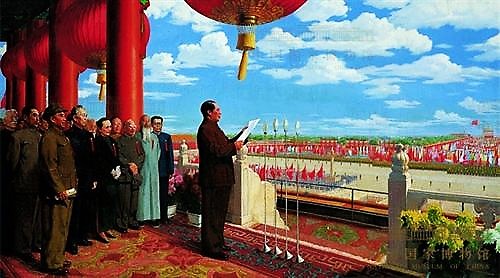
The most famous work on display in Central Hall 1 is Dong Xiwen’s The Founding of the Nation (below), depicting the moment when Mao announced the founding of the People’s Republic in 1949. This is in the approved style with references to classical Chinese motifs, such as the clouds which are supposed to resemble the auspicious lingzhi fungus (don’t ask). And you can’t miss those gigantic red lanterns!

This piece has a particularly curious history. Since its unveiling in 1953, it has gone through multiple “updates” to insert or remove figures in the group on the left. According to historian Chang-Tai Hung*, the following changes were made:
- In 1954, the figure of Gao Gang, a senior party leader, was painted out after he was accused of plotting to seize power.
- In 1967, the figure of Liu Shaoqi, ex-Chairman of the Chinese Communist Party, was deleted after he was condemned as a bourgeois reactionary.
- In 1972, the figure of Lin Boqu, a senior Politburo member, was deleted, ostensibly for opposing the marriage of Mao and his powerful wife Jiang Qing. As they had been married for 24 years by then, one suspects there were other reasons for Lin’s disappearance.
- And then in 1979, after the fall of Jiang Qing’s Gang of Four, all the above three figures were reinstated in the painting. One assumes that this is the final-final version, as everyone in it has been dead for some time.
Something else that’s interesting about this exhibition is the dominance of oil painting. Chinese artists in the 18th and 19th centuries tended to view oils as a strange foreign medium, inferior to the subtlety of ink brush painting. But this attitude changed in the 20th century under the influence of European-trained artists like Xu Beihong and because of China’s developing alliance with the Soviet Union. Russian artist Konstantin Maksimov, who taught at the Chinese Academy of Fine Art in the mid-1950s, is often cited as a major influence. He was a proponent of Social Realism in art, and his painting Sashka the Tractor Driver in Virgin Lands (below) certainly has something in common with the works in Central Hall 1. 

Even if this sort of thing doesn’t appeal, I urge you to visit the National Museum if you can. If you’re pressed for time, focus on the lower ground floor collection which is misleadingly entitled “Ancient China”: this actually contains a vast treasure trove of objects from the Neolithic to the Qing period. And there’s a very good museum shop.
*Comparative Studies in Society and History, Vol 49, No 4, Oct 2007, p.783

Tuesday, 27 September 2016

To Famen and back - and still searching

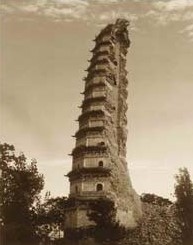
This 9th century Tang Dynasty reliquary, made to hold a fragment of bone from (allegedly) the Buddha himself, is one of my favourite pieces of Chinese Buddhist art, and I was very much hoping to see it on my recent trip to China. But as I trailed round the museum of the Famen Temple at Xian, where it was discovered in the 1980s, it remained stubbornly out of sight. There were all manner of reliquaries on display: originally there were four separate sets containing three decoys (or “shadow bones”) and one true fragment. But I just couldn’t track this one down.
It’s not like it would be easy to miss. Standing around 38cm (15 inches) in height, it is made of dazzling silver-gilt studded with pearls. The base is shaped as a lotus throne, each petal containing an image of the Buddha. The richly adorned figure at the top is a bodhisattva, a celestial being who has chosen to remain on earth to help poor mortal souls (the most well-known bodhisattva is probably Avalokitesvara, worshipped as Guan Yin in the Chinese canon). Down on one knee, he holds up an ornate tray which would have contained the bone fragment (or decoy).
The inscription indicates a date equivalent to 871AD and suggests an imperial commission by the then Emperor Yizong, of whom history has nothing good to say (“unstable, cruel, inexperienced and capricious”, says historian Ann Paludan). In commissioning this piece however, Yizong was simply following a longstanding belief of Chinese Buddhism, which was that great offerings brought great spiritual merit. It didn’t really work for him: he was dead within two years and the Tang dynasty collapsed some forty years later.
I can’t really say why I like this piece, with its eye-smacking degree of bling. I think it’s because under it all, the craftsman has given the bodhisattva (with its slight incline of the head) a genuine air of wanting to do good which isn’t eclipsed by the gaudy jewels or the ghastliness of the imperial patron. He’s going to kneel there and offer that bone (or decoy) because that’s what a bodhisattva does: he doesn't give up on the world.
The discovery of the reliquaries is quite a story in itself. The Famen Temple (built on the site of a much older place of worship) blossomed from the late 6th century onwards as the Sui and Tang Dynasties, both devout Buddhists, came to power. In 1981, half of its famous pagoda collapsed in torrential rain (see below). When repair work began in 1987, an underground chamber was discovered containing a cache of precious religious artefacts, including the four sets of reliquaries.


Today the temple and pagoda have been sensitively restored and look like this.

In 2009 however, the regional government and the temple authorities decided to expand the neighbouring plot of land to create a modern annexe, capable of accommodating the thousands of visitors from China’s burgeoning local tourism trade. So they built this.


Which is so vast that you have to get around on one of these.


But whatever you may think about 21st century bling, I really enjoyed my visit to the Famen, which is just as well as I may have to go back one day to see if I can find the bodhisattva.

Sunday, 21 August 2016

Indus Valley seals: tiny objects of mystery

Having enjoyed the new Bollywood epic Mohenjo Daro, I’m devoting this next post to Indus Valley seals: not just because they feature in the film’s plot but because (like the plot) they are quite mystifying. Even the film’s lead actor, Hrithik Roshan, looks beautifully perplexed.


Mohenjo Daro is one of the most important ancient cities so far discovered on the South Asian subcontinent, rivalled only by Harappa which was the first to be found. Both lie in the Indus valley in modern-day Pakistan and have been dated to the 3rd millennium BC. To put that in context, they were of about the same period as the Minoans in Crete, and pre-dated the reign of Tutankhamun by several centuries.
Although both Harappa and Mohenjo Daro were large and probably wealthy cities, not many of their fine artefacts have survived. Among the most interesting, however, are some tiny pieces of steatite or soapstone, about 4cm square, intricately carved on one side and with a little handle on the back. Historians believe that these were used as seals, perhaps by tradesmen who wanted to mark bundles of goods. The image below from the Metropolitan Museum shows one of these seals (left) and its resulting imprint (right).
Before looking at the images on the seals, it’s worth noting that the symbols along the upper edge are examples of Indus Valley script, which remains undeciphered to this day. In the Internet age, it is humbling to come up against something like this. Until we find a Rosetta stone or an Alan Turing to decode the script, our understanding of the Indus civilizations will remain sadly incomplete.
The images on the seals are equally fascinating. The Met’s is a classic because the animal shown (which is surely a bull or buffalo) has been described by fanciful observers as a unicorn because it has only one horn. I’m not sure anyone truly believes this but it provides good fodder for lengthy academic argument.
Other seals have even more complex imagery. The one below (from the National Museum in Delhi) is famous because some believe that it depicts an early incarnation of the god Shiva, flanked by a rhinoceros, a buffalo, a tiger and an elephant. One of Shiva’s titles was “Lord of the Animals” or “Pashupati”, hence the seal is commonly referred to as the Pashupati seal.

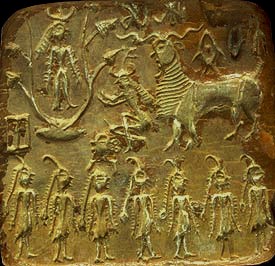
 In the one below (from the Islamabad Museum), a religious ceremony seems to be in progress: in the upper left, a figure stands in a tree while another figure kneels in worship. To the right there seems to be a bull with a human face, while along the bottom is a row of seven women. One suggestion is that they are ancient ancestors of the Matrikas, the Hindu goddesses who always appear in a group of seven.


Some other seals are so strange that they must have been used for purposes other than trade. I can’t imagine how the one below (a horned woman attacking a tiger) would find favour among clients, unless the goods or services were very specific indeed.  Pest control, perhaps?

To be fair, there are some unusual corporate logos still in use today – I’ve never understood how a picture of bees swarming around a dead lion helps to sell Lyle’s Golden Syrup, for example (below). The slogan “Out of the strong came forth sweetness” doesn’t explain much.

But what if the seals’ undeciphered pictograms are actually slogans as well? “Unicorn Cattle Feed – nourish your mythical beast”. The key to the code must surely be found someday, perhaps in a dusty museum archive. Until then, it’s a waiting game.

Tuesday, 9 August 2016

Matteo Ricci in the UCL art collection

At the Public Curating Takeover hosted by University College London last week (a great event, by the way), I was delighted to find this print in the collection. There was no mistaking the image of Matteo Ricci (on the left), perhaps the most famous Jesuit missionary ever to work in China. The figure on the right is named as Paul Siu, about whom more later.
The UCL catalogue does not name the artist, but other sources trace this image to a book (China Illustrata) published around 1668 by a Jesuit scholar named Athanasius Kircher. Whether Kircher actually executed the engraving himself is unclear. Judging from the rather muddled Chinese characters on the altar hangings, I would guess that it wasn’t the work of a Chinese artist.
Ricci first arrived at the fledgling Jesuit mission in southern China in 1582, when Christian missionaries were struggling to gain a foothold. He successfully applied the Jesuit strategy of “cultural accommodation”: adapting to local language and customs to spread the message, while dressing and living as a scholarly Chinese gentleman to win the trust of influential local people. Hence the significance of this image, in which he wears Chinese robes and a Confucian scholar’s hat. By 1601 Ricci had established the first Jesuit mission in Beijing itself and had begun to build direct ties with the Imperial Court, quite a coup by any standards.
For the art world, Ricci was important in at least two ways. First, he laid the way for Giuseppe Castiglione (a Jesuit priest and artist) to become an influential Qing dynasty court painter in the 18th century. Castiglione became noted for elaborate portraits like the one of the Qianlong emperor, below. His work is sometimes dismissed as trivial but he became a key member of the imperial atelier (pretty amazing for a foreign artist) thanks to foundations laid down by Ricci. These days, no exhibition of Qing art is complete without a few Castigliones – his portraits of imperial pet dogs are especially popular. 

But it is Ricci’s role in the clock-making industry that I find most fascinating. Mechanical time-keeping devices (the kind that run on springs and cogs) didn’t exist in 16th century China. When Ricci presented a pair of European clocks to the Wanli emperor in 1601, he set off an absolute craze for the devices. It seems the 17th century Chinese were as keen on modern technology as their modern descendants. And having studied the imported European models, they eventually set up their own clock-making workshops (mainly around Guangdong) which flourished as the growing middle classes all wanted one too. Hardly surprising, as some of the finest Imperial palace clocks looked like this (below), which sold at Christie’s Hong Kong in 2008 for US$4 million.

Best of all, according to the historian Joseph Needham, Matteo Ricci was worshipped well into the 19th century as a patron deity (pu-sa) of the Shanghai guild of clockmakers, due to his role in bringing modern clock-making to China. Now that’s cultural accommodation!
As for Paul Siu, he was born Xu Guangqi and brought up as a good Confucian. He rose through the ranks of Chinese bureaucracy to become a “first grand secretary” in the Ming dynasty, before converting to Christianity in 1601. According to the historian David Mungello, Xu and two other senior civil servants were Matteo Ricci’s most celebrated converts, later known as the Three Pillars of the early Christian church in China.
So the UCL collection’s print is significant because it illustrates both the strength of Matteo Ricci’s missionary zeal (as reflected in his full Chinese dress), and shows next to him an example of his success in the form of Paul Siu.